
An Honours in Information Technology leads to specialist and senior-track roles in cyber security, software engineering, data analytics and IT strategy. At Richfield it is a 1-year, NQF Level 8 qualification, studied online, built around six core modules, one elective and a supervised research project. Whether the extra year pays off depends on which of those four directions you want and on how much your current CV already says about you. This guide sets out what the Honours contains, where each module points, who gets the most from it and who may be better off working for a year first.
Key takeaways
- The Honours covers four career directions: cyber security, software engineering, data analytics and IT strategy and governance, each tied to a named 15-credit module.
- It takes 1 year, sits at NQF Level 8 (SAQA ID 110089) and is a gateway to Master's study.
- Most of the programme is fixed, so your research project is where you actually specialise. Choose the topic with a target job in mind.
What the Honours in Information Technology covers at Richfield
Our Honours in Bachelor of Science in Information Technology is taught by the Faculty of Information Technology, which is led by Dean Dr Kiru Pillay (see his appointment). It shifts the focus from the broad base of the BSc IT to the specialised skills employers hire for. Here is how the modules line up.
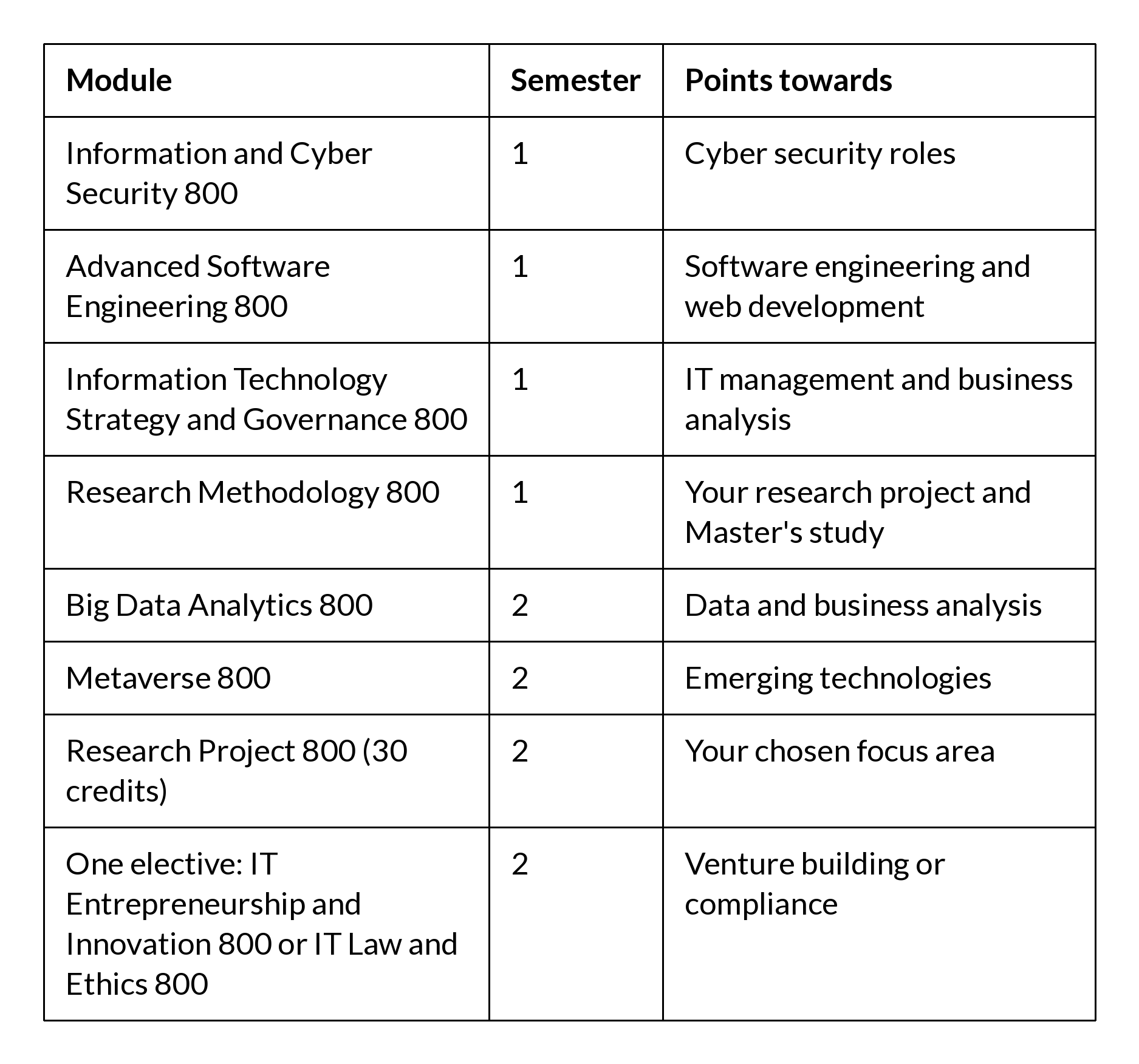
The programme page does not offer formal specialisation tracks. That has a practical consequence. Every Honours student takes the same core, so what separates a cyber security graduate from a data analytics graduate is the elective and the research project. Pick the project topic before the first semester ends, not in the middle of the second.
Career paths after a BSc Honours in IT
The programme page names software engineer, business and data analyst, web developer and cyber security specialist as typical destinations, with systems analysis, data science and IT management also listed. Here is what each direction looks like in practice.
Cyber security
Information and Cyber Security 800 sits in the first semester, which means it can shape your research topic. It gives you the governance and technical grounding that employers expect from a cyber security specialist. Be realistic about what one 15-credit module does, though. Hands-on security work usually also asks for vendor certifications, and Richfield lists partnerships with IBM, AWS, Oracle, Cisco and Salesforce for industry-recognised certifications. Ask admissions which of them apply to your qualification before you enrol. If you would rather start with investigation and evidence handling, our Higher Certificate in Computer Forensics is a separate entry point into the field.
Software engineering
Advanced Software Engineering 800 builds on the programming and software engineering modules in the BSc IT, and leads to software engineer and web developer roles. This is the direction where the Honours adds the least by itself, and it is better to say so. Developer hiring leans heavily on what you have built. The value of the year is the research project: a supervised piece of work that, if you choose well, tackles a problem an employer would recognise. That gives you something substantial to show in an interview.
Data analytics
Big Data Analytics 800 is the anchor module for data and business analyst roles. Data skills are also moving out of the IT department. Nancy Madiba, our Head of Department for Information Systems and Databases, argues in Data literacy is no longer just an IT skill that data literacy is becoming a core graduate attribute. For you, that means analytics roles are not limited to technology companies. A well-chosen research project in a sector you know, such as retail, finance or the public sector, can open more doors than a generic one.
IT strategy and governance
Information Technology Strategy and Governance 800 is the route towards IT management and business analysis. It pairs naturally with the elective. Take IT Law and Ethics 800 if you are heading towards compliance, risk or a management role, where the vocabulary of regulation matters. Take IT Entrepreneurship and Innovation 800 if you intend to build your own product or consultancy.
Is the extra year worth it?
It is worth it when you want to move from doing technical work to specialising or leading it, when you are heading for a Master's degree, or when you want a recognised NQF Level 8 qualification to change direction, for example from a general IT degree into cyber security or data.
It is harder to justify when you already hold a developer role, have a strong portfolio and work somewhere that promotes on output rather than qualifications. A year of study is also a year of workload. Assessment is 40% formative (two assignments per module) and 60% summative (a scenario-based exam per module), with a 50% pass mark, and a supplementary exam available for final marks of 40% to 47%. Fees are published in separate 2027 fee schedules linked from the programme page, so check those before you decide.
Entry requirements and routes in
You qualify with a BSc degree in Information Technology, Information Systems, Computer Science, Informatics or Internet Communication, or an equivalent NQF Level 7 qualification, or through Recognition of Prior Learning. Graduates of our own BSc IT meet the requirement directly.
If your degree sits outside IT, or you have work experience but no degree, there is a 0.5-year online bridging programme. It is non-credit bearing, and the programme page does not promise automatic entry into the Honours, so confirm the route with an admissions advisor before you pay for it.
Frequently asked questions
Is an honours degree worth it in IT?
It is worth it if you are aiming for a specialist or senior role, or for Master's study, and your research project can be tied to that goal. If you already have the role you want, the year may add less than more work experience would.
What jobs can you get with a BSc Honours in IT?
The programme page lists software engineer, business analyst, data analyst, web developer and cyber security specialist, and its FAQ adds systems analysis, data science and IT management.
How long does the BSc Honours in IT take?
1 year, studied mainly online through distance learning, across two semesters.
Do I need a BSc IT to enrol?
No. A BSc in Information Systems, Computer Science, Informatics or Internet Communication also qualifies, as does an equivalent NQF Level 7 qualification or Recognition of Prior Learning.
Take the next step
Read the full module list on the Honours programme page, then start your application or speak to an admissions advisor about which research direction suits the career you are aiming for.