
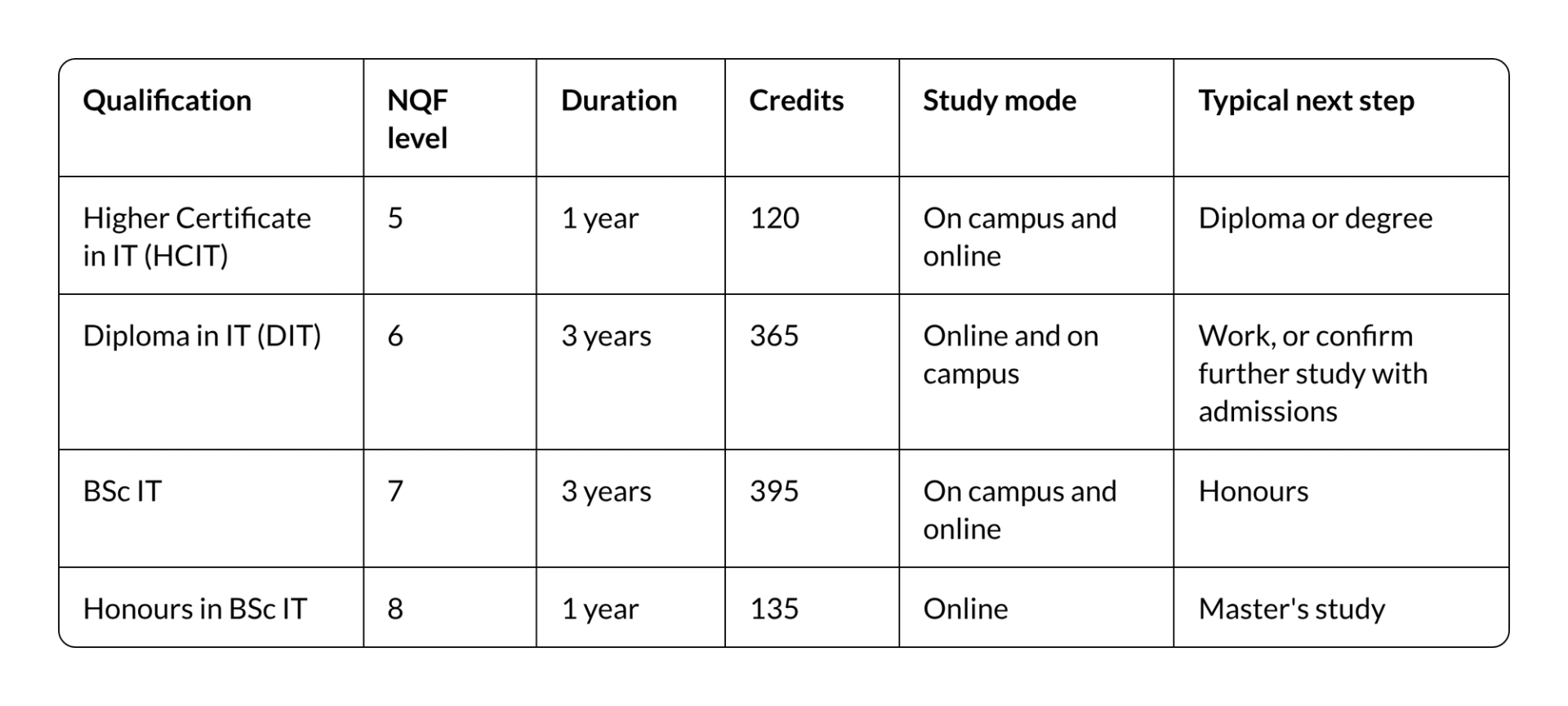
Richfield's IT qualifications run on four levels: a 1-year Higher Certificate in Information Technology (NQF Level 5), a 3-year Diploma in Information Technology (NQF Level 6), a 3-year BSc IT (NQF Level 7) and a 1-year Honours (NQF Level 8). The names sound similar, which is why so many students choose by guesswork. The right starting point depends on your matric endorsement, the kind of work you want to do and how soon you want to be working. Below, each level is set side by side, followed by a plain way to decide where you begin.
Key takeaways
- The Higher Certificate takes 1 year, the Diploma and the BSc IT take 3 years each, and the Honours adds 1 more year after a degree.
- The Diploma builds applied skills for technical and operational roles. The BSc IT combines theory with practical learning, covers areas such as cloud computing, data science, machine learning and the Internet of Things, and opens the route to postgraduate study.
- The ladder has a fork, not a single line: the Higher Certificate leads towards either a diploma or a degree, and only the BSc IT leads to the Honours.
The four IT qualification levels at a glance
Higher Certificate in IT: the 1-year starting point
The HCIT gives you foundational IT knowledge for system development or technical support, and Richfield's programme page describes it as a building block towards a diploma or degree. The modules are deliberately practical: Introduction to Programming 500, Introduction to Web Tech 500, System Software 500, IT Help Desk 500 and a Work Integrated Learning module.
It is the right door if you do not have the endorsement a diploma or degree asks for, if you have been out of school for a while, or if you want to test whether IT suits you before committing 3 years. You can enter with a National Senior Certificate with an endorsement for a Higher Certificate, an NCV at NQF Level 4, mature age exemption (above 23) or Recognition of Prior Learning.
The trade-off is time. If you already qualify for a degree and know you want one, the HCIT adds a year you did not strictly need.
Diploma in IT: the applied route
The Diploma in Information Technology is a 3-year, 365-credit qualification that builds core IT knowledge and hands-on tool skills across networks, databases, software development and systems analysis. From the second year you choose one of three elective streams, and the final year ends with an IT Project and Work Integrated Learning.
Look at the module list and the character of the diploma is clear. You will study Software Development, Networks, Database Systems and M-Commerce, then Quantitative Techniques, IT Project Management and Management Information Systems. The careers named on the programme page include systems analyst, database administrator, information security analyst, software engineer, web developer and computer network architect.
Choose the diploma if you learn best by building and configuring, and you want to be employable at the end of year 3. One caution: the diploma page does not state a formal route from the DIT into the BSc IT. If a degree is part of your long-term plan, ask an admissions advisor about it before you start, not after.
BSc IT: theory combined with practical learning
Learn the skills to build the apps, networks and data systems we all rely on with Richfield's BSc IT degree. It is a 3-year, 395-credit qualification at NQF Level 7 that combines theory with practical learning to prepare you for the real world.
Modules cover programming, web development, information systems, computer networks and databases, alongside cloud computing, data science, machine learning and the Internet of Things (IoT). You'll also study mathematics, statistics, business analysis, computer architecture and server technology. Year 3 adds Artificial Intelligence 700, Cyber Security 700 and Mobile App Development, and the degree ends with Work Integrated Learning. In years 2 and 3 you can specialise in Programming, Emerging Technologies, IT Management or Network Engineering through your electives.
Both the Diploma and the BSc IT are practical, so the useful question is where you want to end up. The Diploma is built around technical and operational roles and a route into work at the end of year 3. The BSc IT adds mathematics, statistics and AI-related modules and opens the route to postgraduate study. Our article on degree versus diploma covers the wider comparison.
Entry is through a National Senior Certificate with a degree endorsement, our HCIT or an equivalent NQF Level 5 IT qualification, mature age exemption or Recognition of Prior Learning. Be honest with yourself about the mathematics. If maths was your weakest matric subject, the HCIT is a lower-risk way into this degree.
Honours in IT: the postgraduate step
The Honours is a 1-year, 135-credit online qualification for graduates who want to deepen their skills in cyber security, software engineering, data analytics or IT strategy, and it is a gateway to a Master's degree. It follows the BSc IT. Our guide to the Honours programme covers the modules in detail.
How study works at every level
Whichever level you pick, the structure of assessment is the same, which makes it easier to move between them. Each module combines formative assessment (tests and assignments, 40%) with a 3-hour summative exam at the end of the semester (60%). The pass mark is 50%, and students with a final mark of 40% to 47% can sit a supplementary exam. Assessments are written online through the learning management system with secure remote proctoring, and results, timetables and deadlines are tracked in the student app. Work Integrated Learning is built into the HCIT, the DIT and the BSc IT, so you leave each level with workplace experience, not only marks.
How to choose where to start
- Work down these in order and stop at the first one that fits.
- You hold a degree endorsement and are comfortable with maths: start with the BSc IT.
- You hold a degree or diploma endorsement and want hands-on skills and a job sooner: start with the Diploma.
- You hold only a Higher Certificate endorsement, an NCV, or you are returning to study as an adult: start with the HCIT.
- You are unsure whether IT is for you: the HCIT is the lowest-commitment way to find out, at 1 year instead of 3.
- Total study time follows from the starting point. A BSc IT followed by the Honours is 4 years. Starting with the HCIT and then moving to the degree and Honours is 5, unless admissions confirms that any HCIT credits count towards the degree. Fees are published in separate 2027 schedules on our fees page, so compare the total cost of each route, not only the first year.
Frequently asked questions
- What is the difference between an IT diploma and an IT degree in South Africa? A diploma (NQF Level 6) focuses on applied skills and prepares you for technical and operational roles. A degree (NQF Level 7) focuses on theory and practical application and opens the route to postgraduate study. At Richfield both take 3 years.
- How long does it take to study IT in South Africa? At Richfield, 1 year for a Higher Certificate, 3 years for a Diploma or BSc IT, and 1 further year for an Honours.
- Can I study IT online at Richfield? Yes. The HCIT, DIT and BSc IT are available online and on campus, and the Honours is offered online.
- Can I move from a diploma to a degree? The Diploma programme page does not set out a formal route into the BSc IT, so confirm it with an admissions advisor before you decide.
Choose your level and apply
Compare the programme pages above, browse all higher certificates, then start your application. An admissions advisor can check your results against each entry route.