Computer science and information technology are related but not the same. Computer science studies how computation works: algorithms, data structures and the theory behind software. Information technology applies computing to build, connect, secure and run the systems that organisations depend on. In the first year or two the two overlap heavily, which is why the names get confused. Richfield does not offer a qualification called computer science. Our IT qualifications, from a 1-year Higher Certificate to an Honours degree, cover the applied side of the field and a good share of the programming, mathematics and AI content that computer science students study. This guide shows where each of our qualifications sits and how to choose between them.
Key takeaways
- Computer science leans towards theory and how software works; information technology leans towards applying technology to real systems and organisations.
- Richfield's IT qualifications run from the 1-year Higher Certificate (NQF Level 5) to the 3-year BSc IT (NQF Level 7) and a 1-year Honours (NQF Level 8), with the BSc IT closest to a computer science degree.
- For most software, data and systems careers the label matters less than the portfolio, the placement and the skills you can show.
The difference in plain terms
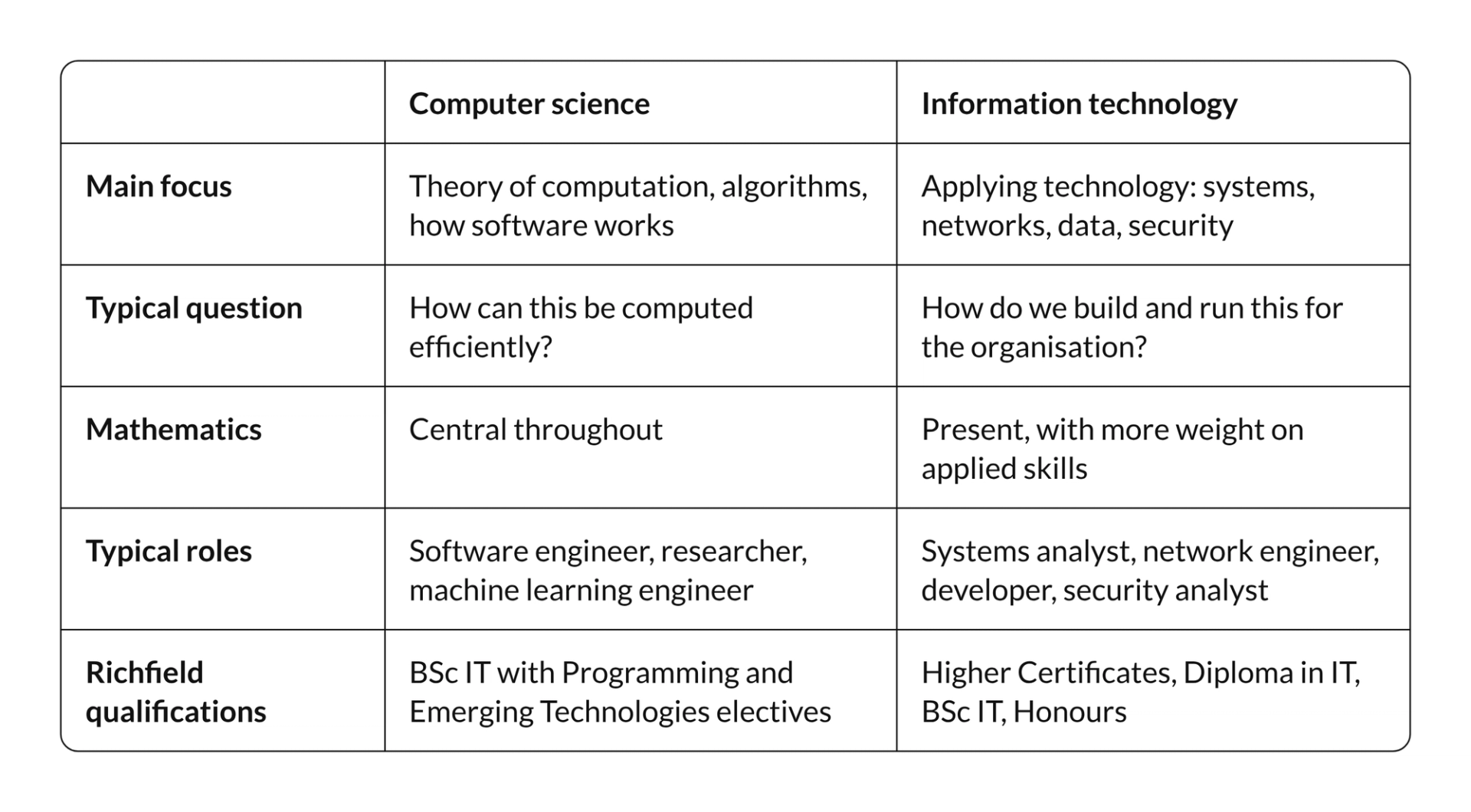
Think about the questions each field asks. A computer scientist asks how a problem can be solved efficiently, and whether it can be solved at all. An IT professional asks how a working solution gets built, connected, secured and kept running for a business. Both write code. The emphasis is different.
What the first year feels like in each field
A typical computer science first year leans on programming, discrete mathematics and the analysis of algorithms. A typical information technology first year puts programming next to networking, information systems and databases. Year 1 of the Richfield BSc IT combines Information Systems, Programming, Web Technology, Networks, Mathematics and Data Science 500 across two semesters. That gives you enough programming and maths to move towards a development or data career, and enough networking and systems content to work in infrastructure or analysis instead.
Where each Richfield qualification sits
Higher Certificate in Information Technology
The HCIT is a 1-year, NQF Level 5 qualification (SAQA ID 82926, 120 credits) and the broadest starting point. Introduction to Programming 500, Introduction to Web Tech 500, Introduction to Computers 500 and System Software 500 cover the foundations of both fields, and IT Help Desk 500 and Work Integrated Learning add the applied side. It is a good test year if you are not sure which direction you prefer.
Higher Certificate in Computer Forensics
The HCCF is a 1-year, NQF Level 5 online programme (SAQA ID 111617) built around Forensic Computing Foundations 500, Network Forensics 500, Internet Forensics 500 and Digital Crime and Investigation 500. It sits firmly on the IT side: investigating cybercrime and supporting information security. Its programme page lists progression into the Diploma in IT and the BSc IT.
Diploma in Information Technology
The Diploma is the most applied option, a 3-year, NQF Level 6 qualification built on Software Development, Networks, Database Systems, M-Commerce, IT Project Management and Management Information Systems. Choose it if you learn by building and want a practical route to a first job.
BSc IT
The BSc IT is a 3-year degree at NQF Level 7 (SAQA ID 122369), and it is the Richfield qualification closest to a computer science degree. It includes Mathematics 511 and 512, programming modules in every year, Computer Architecture 600, Machine Learning 600 and Artificial Intelligence 700. In years 2 and 3 you can specialise in Programming or Emerging Technologies, where electives such as Machine Learning 700 and Autonomous Systems and Robotics 700 take you deeper into the computer science end. If you lean towards the IT end, you can choose IT Management or Network Engineering instead. Core modules in Cloud Computing, Cyber Security 700 and IT Project 700 keep the applied side in view whichever you choose.
BCom (AGA IT)
The BCom (AGA IT) is a different mix altogether. This 3-year, NQF Level 7 degree adds Applied Programming and Automation for Business and IT Governance, Risk and Compliance to an accounting curriculum. It suits you if you want technology skills inside a finance career, with roles such as IT auditor, automation specialist and data analyst on the programme page.
Honours in Information Technology
The Honours is a 1-year online qualification at NQF Level 8 covering cyber security, software engineering, data analytics and IT strategy, and it is a gateway to Master's study. It accepts a BSc in Information Technology, Information Systems, Computer Science, Informatics or Internet Communication, so a computer science graduate from elsewhere can continue here.
Which should you study?
Choose information technology, and the BSc IT in particular, if you want to build software, analyse data, run networks or secure systems for organisations. That covers the majority of technology jobs, and the careers named on the programme page include software engineer, web developer, business and data analyst, database administrator and information security analyst.
A simple self-test helps. If you most enjoy working out why something works, lean towards the computer science end, and choose the Programming or Emerging Technologies electives. If you most enjoy getting something working for the person who will use it, lean towards the IT end.
Choose a dedicated computer science degree elsewhere only if your target is theoretical or research-heavy work, such as designing new algorithms or working on language and compiler internals. It is better to hear that before you enrol than after your first year. Richfield's BSc IT is built around applied computing, so if theory is your goal, compare other options before you commit.
Does the label matter to employers?
Less than most students fear. A hiring manager for a junior developer role looks at what you can build, how you work in a team and whether you have placement experience. Work Integrated Learning is included in every Richfield qualification, so you finish with something concrete to point to. Where the label does matter is postgraduate study, and there the route is open, as the Honours entry list above shows.
A note on names. Some people search for a 'bachelor of computer science and information technology'. Richfield's degree is the Bachelor of Science in Information Technology, so use that name when you compare programmes or apply.
Frequently asked questions
Is computer science the same as information technology?
No. Computer science focuses on the theory of computing and how software works. Information technology focuses on applying technology to build and run systems for organisations. The two share a lot of early content.
What is the difference between an IT and a computer science degree?
A computer science degree usually puts more weight on theory and mathematics. An IT degree such as Richfield's BSc IT combines programming and mathematics with networks, databases, cloud, security and project work.
Does Richfield offer a computer science degree?
No. The closest qualification is the BSc IT, which includes Mathematics, Programming, Computer Architecture, Machine Learning and Artificial Intelligence modules.
Can I do an IT Honours with a computer science degree?
Yes. Our Honours in Information Technology lists Computer Science among the accepted degrees, alongside Information Technology, Information Systems, Informatics and Internet Communication.
Which Richfield programme suits me if I want to work in AI or machine learning?
The BSc IT is the best match. Machine Learning 600 and Artificial Intelligence 700 are core modules, and the Emerging Technologies electives add Machine Learning 700 and Autonomous Systems and Robotics 700. The Honours adds Big Data Analytics 800 if you continue.
Find the right starting point
Browse the Faculty of Information Technology to compare every IT qualification, or start your application and let an admissions advisor match your results to the right entry route. For help comparing levels, read our guide to degree versus diploma.